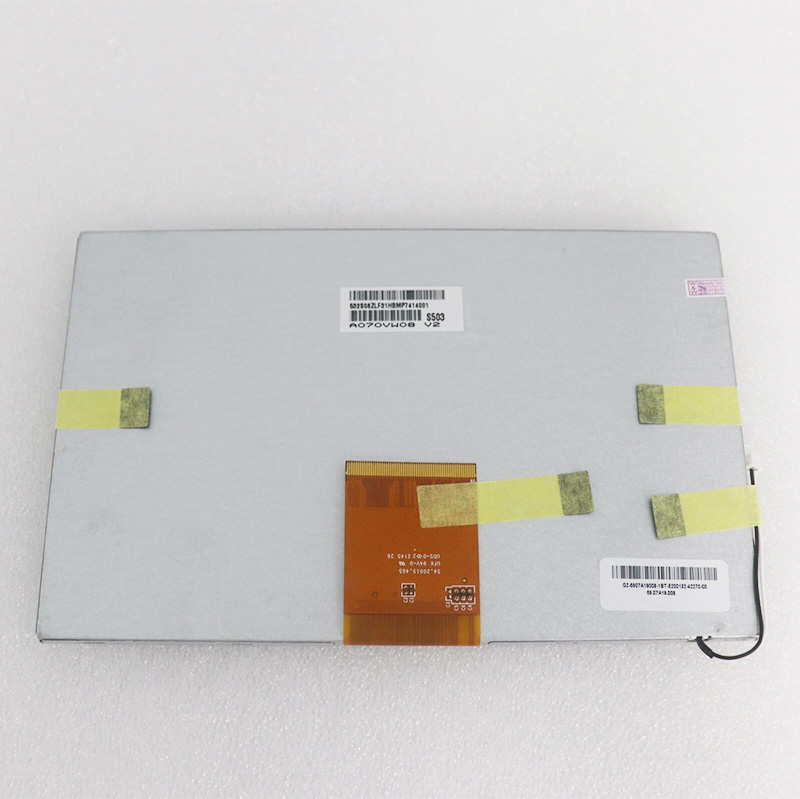
A070VW08 V2 7inch LCD screen AUO
In the intricate world of electronic components, where specifications often blur into a sea of part numbers, the A070VW08 V2 7-inch LCD screen stands out as a notable and widely adopted module. Manufactured by AU Optronics (AUO), a global leader in display technology, this panel has become a cornerstone for countless embedded systems, industrial controls, portable devices, and hobbyist projects. Its enduring presence in the market is a testament to a carefully balanced formula of performance, reliability, and availability.
This article delves beyond the basic datasheet to explore the A070VW08 V2 in depth. We will dissect its technical DNA, understand its ideal applications, and navigate the practical considerations of integration. Whether you are an engineer sourcing a display for a new product, a developer working on a human-machine interface (HMI), or a maker seeking a quality screen for a custom build, a comprehensive understanding of this component's capabilities and context is crucial for project success.
Technical Architecture and Core Specifications
At its heart, the A070VW08 V2 is a 7-inch diagonal TFT-LCD (Thin-Film Transistor Liquid Crystal Display) module with a resolution of 800 x 480 pixels (WVGA). This aspect ratio and resolution were long considered the sweet spot for many embedded applications, offering sufficient detail without imposing excessive processing overhead. The panel utilizes a standard RGB interface, making it compatible with a broad range of controllers and single-board computers. Key specifications include a typical brightness of 300 nits, ensuring good visibility in most indoor environments, and a contrast ratio that delivers clear image differentiation. The module features an integrated LED backlight system, which offers longevity and consistent illumination. Understanding these core specs is the first step in evaluating its suitability. It represents a mature, cost-effective technology that prioritizes stability and broad compatibility over the ultra-high resolutions and refresh rates found in consumer-grade screens.
Defining the Ideal Application Landscape
The A070VW08 V2 was engineered for robustness and longevity, not for multimedia consumption. Its primary domain is the world of industrial and commercial embedded systems. You will find it at the core of factory machine HMIs, patient monitoring devices, point-of-sale terminals, and vehicle telematics systems. Its reliability under continuous operation and across varying temperatures makes it a trusted choice. Beyond industrial settings, this screen has found a significant second home in the maker and prototyping community. Its compatibility with popular platforms like Raspberry Pi (via adaptor boards) and its availability through major component distributors have made it a go-to for custom dashboards, home automation controllers, and portable diagnostic tools. Its application landscape is defined by function over form, where clarity, durability, and interface simplicity are paramount.
The Critical Role of the LVDS Interface
A defining characteristic of the A070VW08 V2 is its use of an LVDS (Low-Voltage Differential Signaling) interface. This is a pivotal technical detail that shapes its integration path. LVDS is a serial communication standard that transmits data as the difference in voltage between two wires. This differential method provides high noise immunity, which is essential for maintaining signal integrity over longer cable runs or in electrically noisy environments like factories. For integrators, this means the display module itself is a "dumb panel"; it requires an external LCD controller board to function. This controller, often called an LVDS converter or driver board, takes a standard video signal (like HDMI, VGA, or RGB TTL from a Raspberry Pi) and translates it into the LVDS protocol the screen understands. This separation adds a step but offers flexibility in sourcing controllers tailored to specific input sources.
Sourcing, Compatibility, and Driver Boards
While AUO is the original manufacturer, the A070VW08 V2 is commonly sourced as a compatible module or through aftermarket suppliers. When procuring, verifying the exact version and compatibility is essential. The "V2" designation is important, as it may have electrical or mechanical differences from earlier revisions that could affect fit and function. The choice of driver board is the most critical integration task. These boards are not universal. One must select a controller that explicitly supports the exact timing parameters and LVDS pin mapping of the A070VW08 V2. Key considerations include:
Input Source: Does the board accept HDMI, VGA, DVI, or RGB signals?
Power Requirements: Does it power the backlight, or is a separate inverter needed?
Form Factor: Does it fit within the intended enclosure?
Touchscreen Support: Many controllers offer optional connections for resistive or capacitive touch overlays, greatly expanding interactivity.

Integration Challenges and Practical Solutions
Integrating this display is rarely a simple plug-and-play affair. Common challenges include managing the power supply for both the logic board and the LED backlight, which may have separate voltage and current requirements. Ensuring clean, stable power is non-negotiable for avoiding display flicker or artifacts.
Physical mounting is another consideration. The module typically has a standard mounting pattern, but careful attention must be paid to bezel design, cable strain relief, and heat dissipation. Furthermore, in projects using a system like a Raspberry Pi, software configuration may be required to correctly set the output resolution and timings to match the native 800x480 of the panel, often involving edits to the config.txt file.
Comparative Analysis and Modern Alternatives
To fully appreciate the A070VW08 V2, one must view it within the broader market context. Compared to newer IPS (In-Plane Switching) panels, it has narrower viewing angles and typically less vibrant color reproduction. However, it often retains advantages in cost, power consumption, and proven reliability for static or data-centric interfaces. Modern alternatives include higher-resolution 7-inch screens (1024x600 or 1280x800) and panels with integrated MIPI-DSI interfaces, which are more common on contemporary SBCs. The choice becomes a trade-off: the A070VW08 V2 offers a vast ecosystem of known-compatible hardware and community knowledge, while newer panels offer enhanced visual performance at the potential cost of integration complexity and price.
FAQs: A070VW08 V2 7-inch LCD Screen
Q1: What is the A070VW08 V2?A: It is a 7-inch, 800x480 resolution TFT-LCD display module from AUO, using an LVDS interface. Q2: What does "LVDS" mean for me?A: It means you cannot connect it directly to an HDMI or VGA port. You need a separate LVDS controller board to convert the signal.
Q3: Is it compatible with Raspberry Pi?A> Yes, but not directly. You must use a compatible HDMI-to-LVDS (or GPIO-to-LVDS) controller board and configure the Pi's output resolution.
Q4: What is the screen's brightness?A: The typical brightness is 300 nits, suitable for most indoor applications.
Q5: Does it have a touchscreen?A: The base A070VW08 V2 panel does not. Touch functionality (resistive or capacitive) is added as a separate overlay, often supported by the driver board.
Q6: Where is it commonly used?A: In industrial HMIs, medical devices, POS systems, embedded kiosks, and DIY/maker projects.
Q7: How do I power it?A: Power requirements vary by driver board. Typically, a single 5V or 12V input powers both the controller and the screen's backlight.
Q8: What's the difference between V1 and V2?A: Revisions may have different pinouts, backlight configurations, or minor performance tweaks. Always confirm your specific version's datasheet.
Q9: Are there plug-and-play kits available?A: Yes, many suppliers sell complete kits including the screen, a matched driver board, cables, and sometimes a frame.
Q10: Should I choose this or a newer IPS screen?A: Choose this for cost-effective, reliable integration with wide driver support. Choose a newer IPS panel for superior viewing angles and color, if your budget and compatibility research allow.
Conclusion
The AUO A070VW08 V2 7-inch LCD is far more than a simple collection of glass and circuitry. It represents a mature, robust, and deeply embedded standard in the world of specialized display technology. Its value lies not in cutting-edge specs, but in its predictable performance, proven reliability, and the extensive ecosystem of compatible hardware that has grown around it. Successful implementation hinges on understanding its LVDS-based architecture and carefully selecting the correct driver board for your application. For engineers and creators working on projects where longevity and stability are critical, this display module continues to offer a compelling and trustworthy solution. It serves as a powerful reminder that in the component world, the right tool for the job is often the one that does its job consistently well, year after year.