- Industrial LCD display
-
Industrial Products
- DC Servo Drive
- AC Servo Drive
- other
- Heidelberg
- FANUC
- IFM
- Meter
- CCD
- Membrane Keypad
- Film
- YOKOGAWA Module
- Card
- ABB
- MITSUBISHI
- FANUC
- KEYENCE
- BECKHOFF
- Honeywell
- HOLLYSYS
- FUJI servo drives
- HP
- solenoid valve
- thermostat
- Siemens adapter
- color oscilloscope
- Fujitsu connector
- CHELIC
- SMC
- CISCO Module
- INTEL
- Key board
- FAIRCHILD
- Motherboard
- Board
- Bearing
- other
- Control Panel
- Contactor
- Circuit
- OMRON
- Relay
- Controller
- Photoelectric Switch
- Photoelectric Sensor
- Original
- Fan
- Motor Driver
- Limit Switch
- Amplifier
- power supply
- LENZE
- Cable
- Encoder
- Sensor
- Transformer
- Fiber Optic Sensor
- Protection Relay
- Temperature Controller
- Proximity Switch
- Switch Sensor
- Siemens
- Industrial board
- HMI Touch Glass
-
HMI Full Machine Whole unit
- OMRON HMI Touch Panel
- Siemens HMI Touch Panel
- Mitsubishi HMI Touch Panel
- Allen-Bradley automation HMI Touch Panel
- DELTA HMI Touch Panel
- EVIEW DELTA HMI Touch Panel
- KINCO DELTA HMI Touch Panel
- HITECH HMI Touch Panel
- WEINTECK HMI Touch Panel
- TECVIEW HMI Touch Panel
- WEINVIEW HMI Touch Panel
- PRO-FACE HMI Touch Panel
- SIMATIC HMI Touch Panel
- AMPIRE HMI Touch Panel
- HEIDELBERG HMI Touch Panel
- PANASONIC HMI Touch Panel
- PATLITE HMI Touch Panel
- KYOCERA HMI Touch Panel
- KEYENCE HMI Touch Panel
- WEINVIEW HMI Touch Panel
- HITECH HMI Touch Panel
- FUJI HMI Touch Panel
- HAKKO HMI Touch Panel
- SCHNEIDER HMI Touch Panel
- SAMKOON touch panel
- other
- Module
- lcd inverter
- Membrane Keypad Switch
- Winni Touch Screens
- Frequency Inverter
- Servo Motor
- PLC




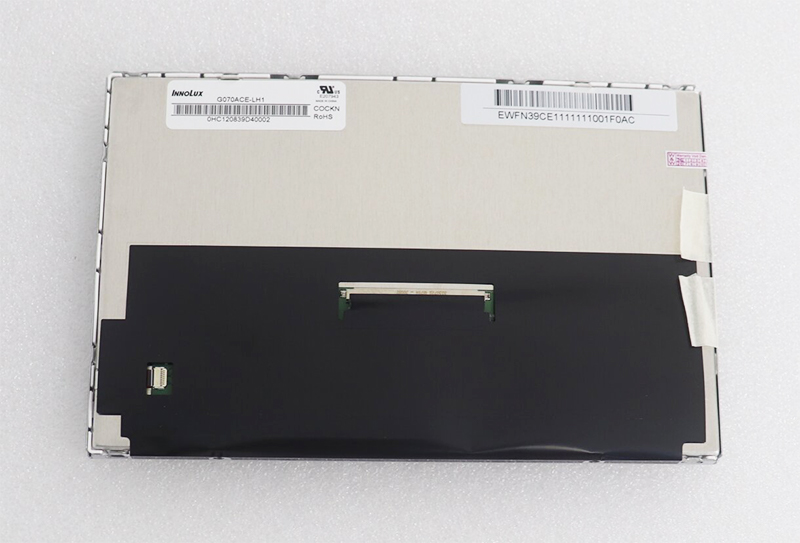
G070ACE-LH1 Innolux 7inch 800×480 LCD DISPLAY
In the intricate world of electronic components, the display often serves as the critical bridge between a device's functionality and the user's experience. For engineers, product designers, and procurement specialists navigating the landscape of industrial and embedded systems, selecting the right LCD module is a decision that balances technical specifications, reliability, and cost. This article delves into a detailed examination of one such pivotal component: the G070ACE-LH1 from Innolux.
This 7-inch display, with its 800×480 resolution, represents a workhorse in numerous applications, from industrial human-machine interfaces (HMIs) and point-of-sale terminals to transportation systems and medical devices. Beyond its basic specs, the G070ACE-LH1 encapsulates a series of engineering choices and performance characteristics that determine its suitability for demanding environments. Our exploration will move beyond surface-level data sheets to analyze its core technology, visual performance, integration challenges, application-specific strengths, and its position within the competitive market, providing a comprehensive resource for making an informed component selection.
Decoding the Core Technology: TFT-LCD and Interface Architecture
At the heart of the Innolux G070ACE-LH1 lies a Thin-Film Transistor Liquid Crystal Display (TFT-LCD) panel. This active-matrix technology utilizes a transistor for each pixel, enabling faster response times and superior image stability compared to older passive-matrix designs. The 800×480 (WVGA) resolution on a 7-inch diagonal translates to a pixel density of approximately 133 PPI, which is optimized for readability and clear iconography in arm's-length viewing scenarios typical of industrial controls.
A critical aspect of this module is its LVDS (Low-Voltage Differential Signaling) interface. LVDS is the industry-standard digital video interface for such displays, prized for its high-speed data transmission with low noise and low power consumption. The G070ACE-LH1's integration of an LVDS receiver simplifies the connection to a host processor or controller board, reducing electromagnetic interference (EMI)—a vital consideration in electrically noisy environments. This foundational technology stack ensures a reliable and clean signal pathway from the source to the screen.

Visual Performance and Ruggedness in Detail
Visual performance is not merely about resolution. The G070ACE-LH1 typically offers a brightness level in the range of 300-400 nits, making it viewable under indoor ambient light and in some shaded outdoor conditions. Its contrast ratio defines the depth between blacks and whites, crucial for text legibility. Furthermore, the color gamut coverage determines how accurately it can reproduce colors specified in the interface design.
Ruggedness is a non-negotiable trait for embedded displays. This module is often built with a robust construction, featuring a durable surface (like hard-coated or anti-glare treatment) to resist scratches and abrasion. Its operating temperature range, often spanning from -20°C to 70°C or similar, allows deployment in unregulated environments, from freezing cold storage facilities to hot factory floors. This combination of optical performance and physical durability defines its operational envelope.
Integration Essentials: Power, Backlight, and Touch
Many implementations of this display module incorporate a resistive or capacitive touchscreen overlay. Integrating touch adds a layer of complexity, requiring a separate touch controller and firmware for calibration and gesture recognition. Designers must account for the additional physical thickness, potential optical clarity reduction, and the communication protocol (often USB or I2C) for the touch data when planning the system integration.
Targeted Applications and Use Case Analysis
The G070ACE-LH1 finds its niche in markets where reliability trumps ultra-high resolution. In Industrial HMI systems, it serves as the control and monitoring interface for PLCs and machinery, where its readability and wide temperature range are paramount. Point-of-Sale (POS) terminals benefit from its cost-effectiveness and clear display for transaction information.
Other key applications include transportation infotainment in buses or trains, medical monitoring devices where consistent performance is critical, and kiosks for information or self-service. In each case, the module's value is proven not by cutting-edge specs, but by its proven stability, long-term availability, and ability to perform consistently over many years—a crucial factor for products with long lifecycles.
Comparative Landscape and Alternative Considerations
Placing the G070ACE-LH1 in the broader market context is essential. It competes directly with similar 7-inch WVGA modules from manufacturers like AUO, Tianma, and BOE. Key differentiators become the specific optical bonding options (air-gap vs. optical-bonded for better sunlight readability), the quality of the polarizer, and the exact mechanical footprint.
Designers must also consider alternatives. Would a higher-resolution 1024x600 display be necessary? Is a sunlight-readable, high-brightness (1000+ nits) panel required? Could a smaller 5-inch or larger 10.1-inch display improve the user experience? The choice of the G070ACE-LH1 often represents the optimal balance point in the cost-reliability-performance triangle for mainstream embedded projects.
Designing for Longevity and Supply Chain Strategy
For products intended for field deployment for a decade or more, component longevity is a strategic concern. The G070ACE-LH1, as part of Innolux's standard product line, is typically slated for longer production lifecycles than consumer-grade panels. Engaging with authorized distributors or directly with Innolux to understand the End-of-Life (EOL) roadmap is a critical step in risk mitigation.
A robust supply chain strategy may involve qualifying a second-source compatible display module from another manufacturer or purchasing a lifetime buy of critical components. Understanding the lead times, minimum order quantities, and the manufacturer's commitment to the industrial market is as important as evaluating the technical specifications when designing for sustainable, long-term product success.
FAQs
Q: Is this display module good for long-term product designs?A: Yes, as part of Innolux's industrial-focused lineup, it generally has a longer lifecycle than consumer
panels, but always verify EOL schedules.
In conclusion, the Innolux G070ACE-LH1 7-inch display module exemplifies a mature, reliable solution engineered for the rigorous demands of embedded and industrial systems. Its value proposition is built not on being the most advanced, but on being a proven, stable, and well-supported component. From its robust TFT-LCD core and clean LVDS interface to its consideration for rugged environments and long-term supply, it addresses the fundamental needs of professional product development.
Selecting this module is a decision that prioritizes operational reliability, ease of integration, and lifecycle management over cutting-edge pixel density. For engineers and designers building interfaces that must work flawlessly day in and day out, understanding the depth of features and trade-offs encapsulated in this display is key to creating durable and effective end products. It remains a testament to the principle that in industrial technology, consistent performance often outweighs fleeting specifications.