- Industrie-LCD-Display
-
Industrial Products
- DC Servo Drive
- AC Servo Drive
- other
- Heidelberg
- FANUC
- IFM
- Meter
- CCD
- Membrane Keypad
- Film
- YOKOGAWA
- Card
- ABB
- MITSUBISHI
- FANUC
- KEYENCE
- BECKHOFF
- Honeywell
- HOLLYSYS
- FUJI servo drives
- HP
- solenoid valve
- thermostat
- Siemens adapter
- color oscilloscope
- Fujitsu connector
- CHELIC
- SMC
- CISCO
- INTEL
- Key board
- FAIRCHILD
- Der Aufsichtsrat
- Board
- Bearing
- other
- Control Panel
- Contactor
- Circuit
- Omron
- Relais.
- Der controller
- Optoelektronische schalter
- Optoelektronische sensoren
- Original
- Fan
- Motortreiber
- Endschalter
- Verstärker
- power supply
- LENZE
- Cable
- Encoder
- Sensor
- Transformator
- Fiber Optic Sensor
- Schutzrelais
- Temperaturregler
- Näherungsschalter
- Switch Sensor
- Siemens
- PCB
- HMI Touch-Glas
-
HMI-Vollautomat Ganze Einheit
- OMRON HMI Touch Panel
- Siemens HMI Touch Panel
- Mitsubishi HMI Touch Panel
- Allen-Bradley Automatisierung HMI Touch
- DELTA HMI Touch Panel
- EVIEW DELTA HMI Touch Panel
- KINCO DELTA HMI Touch Panel
- HITECH HMI Touch Panel
- WEINTECK HMI Touch Panel
- TECVIEW HMI Touch Panel
- WEINVIEW HMI Touch Panel
- PRO-FACE HMI Touch Panel
- SIMATIC HMI Touch Panel
- AMPIRE HMI Touch Panel
- HEIDELBERG HMI Touch Panel
- PANASONIC HMI Touch Panel
- PATLITE HMI Touch Panel
- KYOCERA HMI Touch Panel
- KEYENCE HMI Touch Panel
- WEINVIEW HMI Touch Panel
- HITECH HMI Touch Panel
- FUJI HMI Touch Panel
- HAKKO HMI Touch Panel
- SCHNEIDER HMI Touch Panel
- SAMKOON touch panel
- andere
- Module
- LCD Wechselrichter
- Membran Tastenfeld Schalter
- Winni Touch Screens
- Frequenzumrichter
- Servo Motor
- PLC




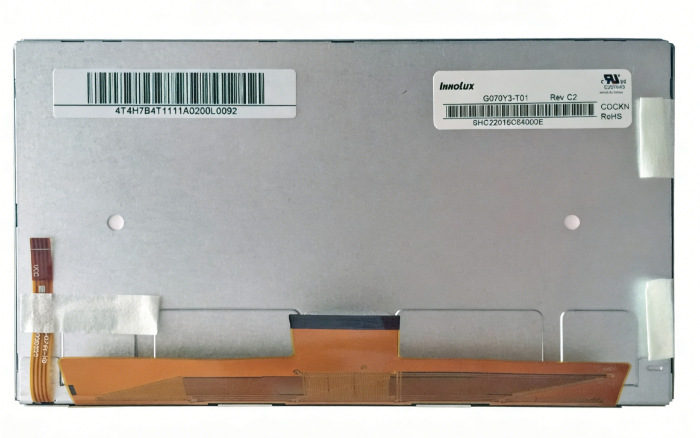
new Chimei Innolux 800*480 7inch LCD panel G070Y3-T01
In the ever-evolving landscape of display technology, where every pixel and refresh rate is scrutinized, the introduction of a new panel can signal a shift in possibilities for engineers and product designers. The Chimei Innolux G070Y3-T01 emerges as a noteworthy contender in the realm of small-format displays, promising to bridge the gap between cost-effective manufacturing and reliable performance. This 7-inch LCD panel, with its 800 x 480 resolution, is not merely a component; it is a foundational element that will power a new generation of human-machine interfaces, portable devices, and industrial equipment.
This article delves into a comprehensive analysis of the G070Y3-T01. We will move beyond basic specifications to explore its architectural nuances, performance characteristics in real-world scenarios, and the specific market applications it is poised to revolutionize. From its optical performance and power profile to its mechanical integration challenges and future outlook, we provide a deep dive intended for procurement specialists, hardware engineers, and tech enthusiasts seeking to understand the true value proposition of this specific display solution.
Architectural Overview and Core Specifications
The Chimei Innolux G070Y3-T01 is built on a TFT-LCD (Thin-Film Transistor Liquid Crystal Display) architecture, a proven technology known for its stability and color reproduction. The panel's 800 x 480 pixel resolution on a 7-inch diagonal translates to a pixel density of approximately 133 PPI (Pixels Per Inch). This WVGA format is a strategic choice, offering a clear visual canvas for information display without imposing excessive processing overhead on the system's graphics controller, making it ideal for embedded systems.
At its heart, the panel utilizes a RGB vertical stripe sub-pixel arrangement and typically features a standard LVDS (Low-Voltage Differential Signaling) interface. This interface is crucial for its robustness, ensuring high-speed data transmission with reduced electromagnetic interference, a key requirement in dense electronic assemblies. The module's outline dimensions, bezel width, and active area are precisely defined, demanding careful attention during the mechanical design phase of the end product to ensure a seamless fit and optimal user experience.

Optical Performance and User Experience
The visual fidelity of any display is paramount. The G070Y3-T01 panel delivers a balanced optical performance tailored for readability under various conditions. Its brightness, typically ranging around 300 to 400 nits, ensures content remains visible in moderately lit indoor environments. The contrast ratio defines the depth between blacks and whites, contributing to text clarity and image legibility.
Furthermore, the viewing angle performance, specified using standards like 6 o'clock or 12 o'clock direction, determines how the image quality holds up when viewed from off-center positions. For kiosks or multi-person devices, wide viewing angles are essential. The color gamut coverage, often referencing the NTSC standard, indicates the range of colors the panel can reproduce. For this model, the gamut is sufficient for accurate representation of icons, graphs, and interfaces, though it is not targeted at high-end multimedia consumption, aligning with its application-focused design philosophy.
Power Efficiency and Thermal Considerations
In portable and battery-operated devices, power consumption is not just a specification—it's a critical design constraint. The G070Y3-T01 is engineered with efficiency in mind. The power draw of the backlight unit (BLU), which is often the most power-hungry part of an LCD, is optimized. Designers can often implement PWM (Pulse-Width Modulation) dimming to further reduce power based on ambient light conditions, extending battery life significantly.
Effective thermal management is a direct consequence of power efficiency. Lower power consumption translates to less heat dissipation within the device enclosure. This reduces the risk of overheating, which can affect not only the panel's longevity and color consistency but also the reliability of adjacent components. Engineers must consider the panel's thermal characteristics in their system design to ensure stable operation over the product's entire lifespan, especially in sealed or passively cooled industrial environments.
Integration Challenges and Interface Compatibility
Integrating a display like the G070Y3-T01 into a final product involves navigating several technical challenges. The LVDS interface, while robust, requires a compatible controller on the host system's mainboard. The number of data lanes and clock signals must match, and the firmware must be configured with the correct timing parameters (porch, sync) to initialize the panel correctly—a process that can be a hurdle during prototyping.
Mechanically, the panel is a fragile component. The design must include secure mounting points that avoid stress on the glass, proper grounding to prevent static damage, and a bezel or frame that protects the edges. Furthermore, the choice of touch panel overlay (if required), such as resistive or projected capacitive, adds another layer of complexity regarding optical bonding, thickness, and driver compatibility. Successful integration is a multidisciplinary effort between electrical, mechanical, and software engineering.
Target Applications and Market Fit
The specifications of the G070Y3-T01 make it a versatile solution for a well-defined set of applications. Its primary strength lies in the industrial and commercial sectors. You will find this panel at the heart of factory automation HMIs (Human-Machine Interfaces), where it provides reliable status readouts and control inputs. It is equally suited for point-of-sale (POS) systems, self-service kiosks, and portable medical diagnostic devices, where clarity and durability are prioritized over ultra-high resolution.
Beyond industrial use, it serves as an excellent display for embedded computing platforms like Raspberry Pi or other Single-Board Computers (SBCs), enabling hobbyists and developers to build custom control panels and compact monitors. The panel's format is also a fit for in-vehicle infotainment systems in low-to-mid range vehicles or as secondary displays for auxiliary controls, proving that a well-executed standard resolution can meet a vast array of practical needs.
The Competitive Landscape and Future Trajectory
Positioning the G070Y3-T01 within the competitive market reveals its strategic role. It does not compete with high-PPI smartphone displays or fast-gaming panels. Instead, it occupies the essential, value-driven segment where reliability, long-term supply, and cost-effectiveness are the primary purchasing drivers. It competes with similar offerings from other manufacturers like AUO or HannStar, with differentiation often coming down to specific optical specs, connector type, or price per unit in volume.
Looking forward, the trajectory for such panels is not about drastic resolution increases but about incremental enhancements. We can expect to see improvements in power efficiency through advanced LED backlights, wider operating temperature ranges for harsher environments, and potentially the integration of more streamlined interfaces like MIPI-DSI to simplify design. The core value proposition—providing a dependable, readable visual interface—will remain constant, even as the underlying technology subtly evolves to meet new efficiency and integration standards.
FAQs
Q10: Is this panel suitable for outdoor use in sunlight?A10: With a standard brightness of ~300-400 nits, it is not ideal for direct sunlight readability. Sunlight-readable versions require much higher brightness (1000+ nits).
Conclusion
The Chimei Innolux G070Y3-T01 7-inch LCD panel exemplifies how targeted engineering creates lasting value in the component market. It is not designed to win spec sheet battles with consumer-grade screens but to excel in the demanding, real-world environments of industrial, commercial, and embedded applications. Its combination of adequate resolution, reliable LVDS interface, and balanced optical performance makes it a workhorse component for designers who prioritize durability, integration simplicity, and cost control.
Ultimately, the significance of such a panel lies in its enablement of innovation elsewhere. By providing a dependable and affordable visual interface, it allows engineers and creators to focus their resources on the unique functionalities of their products. As we move towards an increasingly interconnected world of machines and devices, robust and accessible display solutions like the G070Y3-T01 will remain fundamental building blocks, quietly powering the interfaces that drive our daily operations and interactions.