- Industrial LCD display
-
Industrial Products
- DC Servo Drive
- AC Servo Drive
- other
- Heidelberg
- FANUC
- IFM
- Meter
- CCD
- Membrane Keypad
- Film
- YOKOGAWA Module
- Card
- ABB
- MITSUBISHI
- FANUC
- KEYENCE
- BECKHOFF
- Honeywell
- HOLLYSYS
- FUJI servo drives
- HP
- solenoid valve
- thermostat
- Siemens adapter
- color oscilloscope
- Fujitsu connector
- CHELIC
- SMC
- CISCO Module
- INTEL
- Key board
- FAIRCHILD
- Motherboard
- Board
- Bearing
- other
- Control Panel
- Contactor
- Circuit
- OMRON
- Relay
- Controller
- Photoelectric Switch
- Photoelectric Sensor
- Original
- Fan
- Motor Driver
- Limit Switch
- Amplifier
- power supply
- LENZE
- Cable
- Encoder
- Sensor
- Transformer
- Fiber Optic Sensor
- Protection Relay
- Temperature Controller
- Proximity Switch
- Switch Sensor
- Siemens
- Industrial board
- HMI Touch Glass
-
HMI Full Machine Whole unit
- OMRON HMI Touch Panel
- Siemens HMI Touch Panel
- Mitsubishi HMI Touch Panel
- Allen-Bradley automation HMI Touch Panel
- DELTA HMI Touch Panel
- EVIEW DELTA HMI Touch Panel
- KINCO DELTA HMI Touch Panel
- HITECH HMI Touch Panel
- WEINTECK HMI Touch Panel
- TECVIEW HMI Touch Panel
- WEINVIEW HMI Touch Panel
- PRO-FACE HMI Touch Panel
- SIMATIC HMI Touch Panel
- AMPIRE HMI Touch Panel
- HEIDELBERG HMI Touch Panel
- PANASONIC HMI Touch Panel
- PATLITE HMI Touch Panel
- KYOCERA HMI Touch Panel
- KEYENCE HMI Touch Panel
- WEINVIEW HMI Touch Panel
- HITECH HMI Touch Panel
- FUJI HMI Touch Panel
- HAKKO HMI Touch Panel
- SCHNEIDER HMI Touch Panel
- SAMKOON touch panel
- other
- Module
- lcd inverter
- Membrane Keypad Switch
- Winni Touch Screens
- Frequency Inverter
- Servo Motor
- PLC


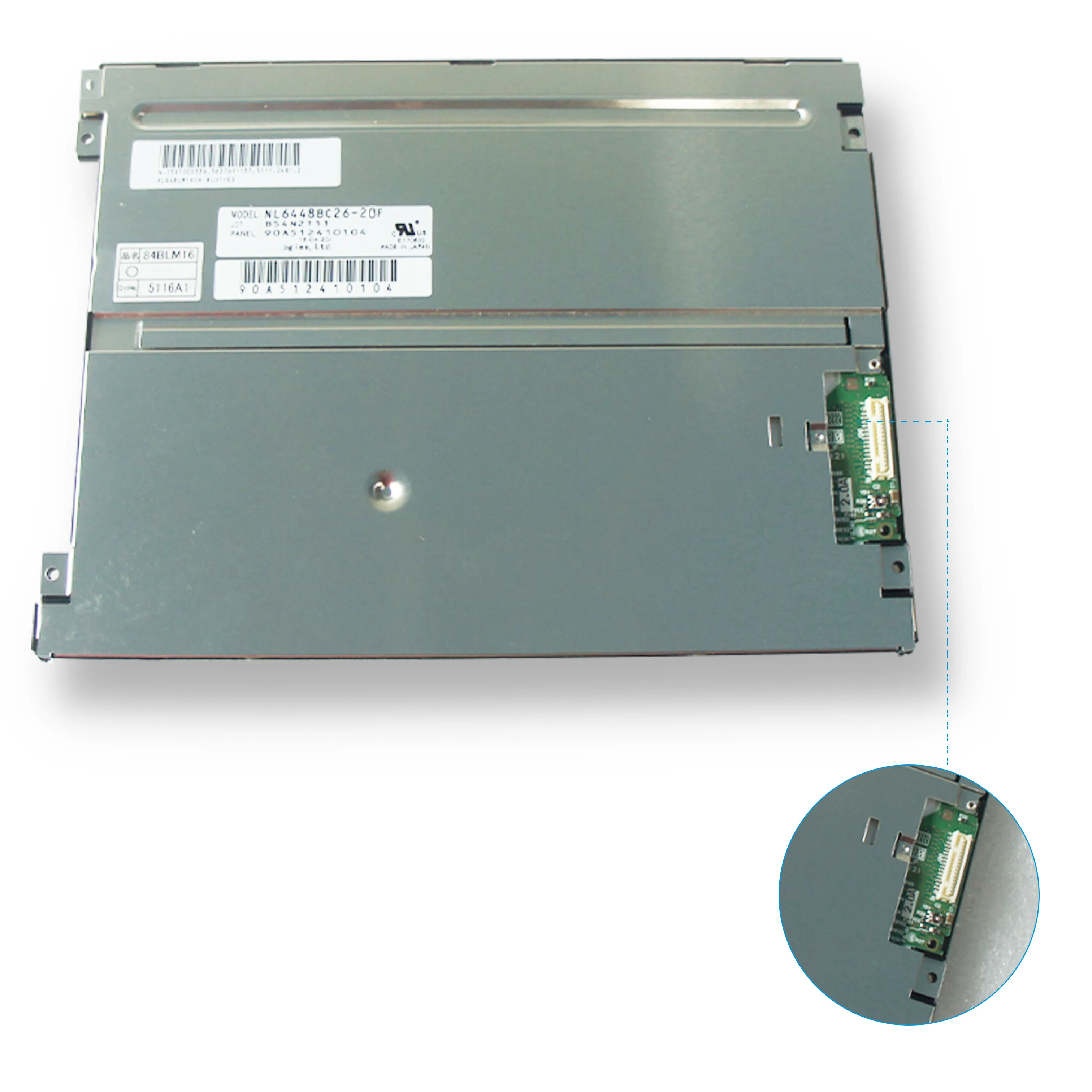

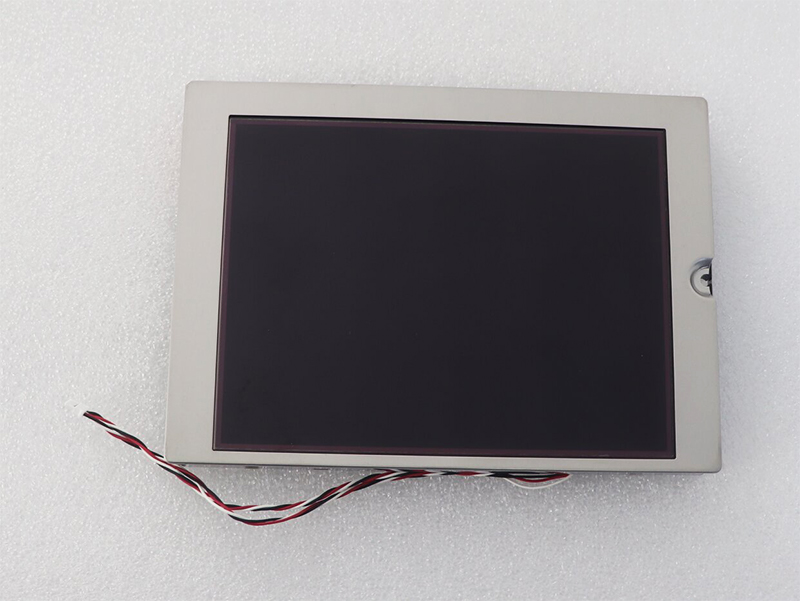
Original 5.7" Industrial LCD Panel DISPLAY KCG057QVLDG-G760
In the world of industrial automation and embedded systems, the display is more than a peripheral; it is the primary interface between human operators and complex machinery. Among the myriad of available panels, the Original 5.7" Industrial LCD Panel Display KCG057QVLDG-G760 occupies a specific and critical niche. This article does not merely reprint a datasheet. Instead, it explores the strategic considerations behind choosing this specific model—a 5.7-inch, 640x480 resolution VGA display with a Sharp-branded heritage. We will dissect its engineering architecture, its role in legacy system upgrades, its optical performance under harsh lighting, and its interface compatibility with modern controllers. Understanding this panel requires moving beyond pixel counts to evaluate its true value: reliability in extreme environments, optical clarity for critical readings, and the long-term support that defines a genuine industrial component. This analysis is designed for engineers, procurement specialists, and system integrators who need to decide if this panel is the correct fit for their application, or if it merely looks correct on paper.
The KCG057QVLDG-G760 is not a generic component; it is a product of Sharp Corporation, a manufacturer with a decades-long reputation for high-reliability LCDs. This heritage is critical for industrial applications because it signifies a commitment to supply continuity and rigorous quality control that generic off-brand panels cannot match. The panel employs a-Si TFT (amorphous silicon thin-film transistor) technology, a mature and highly stable process. While newer technologies like LTPS or IGZO offer higher resolutions, a-Si remains the gold standard for applications where long-term availability and thermal stability are non-negotiable. The 640x480 VGA resolution at a 5.7-inch diagonal yields a crisp pixel density for UI elements, making text and basic icons highly legible. Crucially, this panel is built on Sharp’s industrial platform, meaning its backlight design and driver ICs are selected for extended lifecycle management. Engineers choosing this panel benefit from a known failure mode profile, predictable electrical characteristics, and a form factor that has become a de facto standard for many industrial HMI enclosures. It is a choice that prioritizes stability over novelty, a vital distinction in mission-critical systems.
One of the most significant challenges in industrial display design is ensuring readability under uncontrolled ambient light. The KCG057QVLDG-G760 addresses this through a combination of a normally white, TN (Twisted Nematic) mode and a specific anti-glare surface treatment. TN technology, while often dismissed for poor viewing angles in consumer electronics, is deliberately chosen here for its superior response time and high contrast ratio in a static industrial setting. The typical response time of 10-20ms (Tr+Tf) is more than adequate for updating machine status data without ghosting, a critical factor when operators rely on real-time sensor readings. The key specification to focus on is the luminance, which this panel delivers at approximately 350 cd/m² (typical). This brightness level is calibrated specifically for indoor industrial environments where ambient lighting can shift from dim machine bays to brightly lit control rooms. The built-in CCFL or LED backlight (depending on the exact revision of the G760) is designed for a long operational life (often exceeding 50,000 hours to half-brightness). This ensures that the panel does not become a scheduled maintenance item, reducing total cost of ownership over a typical 5- to 10-year deployment cycle. The viewing cone, while narrow (typically 70/70/40/60 degrees), is perfectly optimized for a single operator positioned directly in front of the panel.
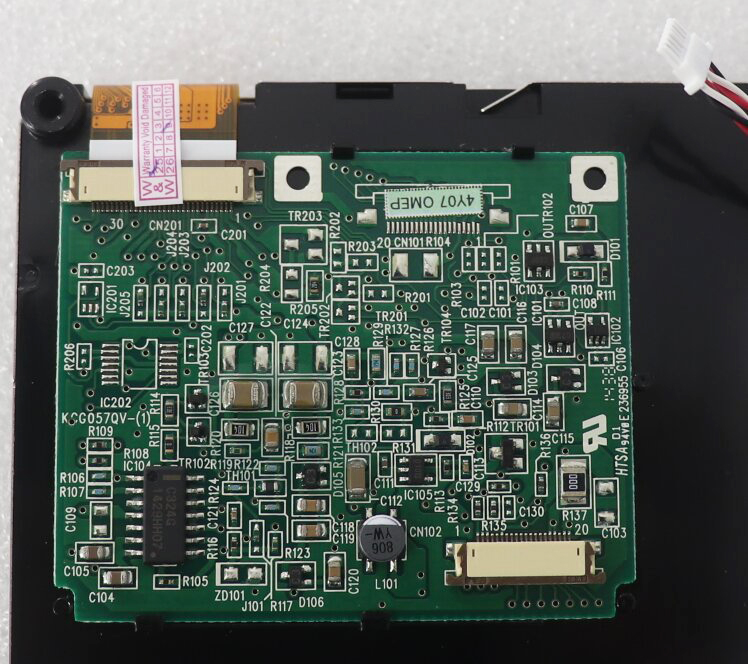
Successful integration of the KCG057QVLDG-G760 hinges on understanding its electrical interface. This panel utilizes a parallel 8-bit RGB interface, a standard in the industrial world that offers a direct, low-latency connection to a microcontroller or a dedicated TFT controller. While not as streamlined as LVDS or MIPI interfaces found in modern consumer panels, the parallel RGB interface provides immense flexibility for control and timing. There is no onboard frame buffer; the panel must be driven in real-time with a constant stream of pixel data and synchronizing signals (VSYNC, HSYNC, DE, CLK). This forces the system designer to have tight control over timing margins, but it also eliminates the latency and complexity of serializing and deserializing data. Interfacing this panel typically requires an FPGA or a high-performance ARM Cortex-M7 or Cortex-A class processor equipped with a parallel LCD controller. When migrating from an older display, engineers must carefully map the 6-bit or 8-bit color data lines to the panel’s pinout. Many successful integrations use a breakout adapter board or a custom PCB to route the 38-pin or 41-pin connector to a standard development kit. The lack of embedded DisplayPort or HDMI is not a shortcoming; it is an intentional design for deterministic, line-synchronous video delivery critical for failure-critical applications.
The primary market for the KCG057QVLDG-G760 is not new, high-volume products, but rather sustainment and upgrade of existing systems. Many medical devices, CNC controllers, and test equipment built in the late 1990s and 2000s originally utilized this exact panel. When one of these panels fails in the field, the immediate instinct is to replace it with a modern widescreen display. This is a significant engineering risk. The mechanical cutout, the bezel mounting points, the connector location, and the electrical voltage levels are all precisely defined for the G760. Swapping to a different panel often forces a complete redesign of the front panel, the power supply, and the main logic board. Therefore, the value proposition of the KCG057QVLDG-G760 is its drop-in compatibility. The original manufacturer maintains tight control over the FPC (Flexible Printed Circuit) cable length and connector polarity. For a system integrator, sourcing an original panel eliminates months of certification testing and mechanical re-engineering. The risk of counterfeit or "Grade B" panels on the open market is high, but certified original units guarantee the same gamma curve, the same predictable ghosting behavior, and the same environmental resilience (operating temperature of -20°C to +70°C) as the day the system was first qualified. This continuity is often worth a premium over a generic alternative.
No component is perfect for every scenario. The KCG057QVLDG-G760 excels in scenarios requiring proven reliability, optical stability, and zero mechanical rework. Its TN panel, however, falls short in applications requiring wide viewing angles—for example, an elevator panel viewed from an angle or a public kiosk. For those uses, an IPS panel would be more appropriate. Additionally, its 640x480 resolution is restrictive for modern graphical interfaces that demand detailed data dashboards or video playback. If the application requires a modern touch screen with capacitive multi-touch or requires sunlight readability exceeding 1000 cd/m², this panel is the wrong choice. The key to intelligent selection is a cost-benefit analysis of integration overhead. If the system already exists and the display fails, the logistics hassle of sourcing a high-quality original G760 is far lower than the engineering cost of redesigning the housing, writing new drivers for a different timing controller, and re-certifying the device for safety (such as UL or CE). For new designs starting from a blank sheet, however, a more modern panel with LVDS or eDP interface, higher resolution, and an integrated touch controller will likely provide lower system cost and better performance. The G760 is a specialist tool for a specific job: keeping critical infrastructure running with minimal disruption.
Sourcing an Original KCG057QVLDG-G760 requires far more diligence than a routine online purchase. This is a high-value, low-volume component that has been discontinued by Sharp for initial production runs but remains available through authorized industrial distributors who carry surplus or last-time-buy inventory. The market is rife with remanufactured panels, or "compatible" units that may contain used or reconditioned backlights and a-Si glass that has been salvaged from scrapped monitors. These non-original units often fail prematurely within months. A genuine original panel will have consistent serial numbering, a specific anti-glare texture that is hard to replicate, and precise labeling on the rear metal frame. Engineers must request a Certificate of Conformance (COA) from their supplier, verifying the manufacturing date and batch code. Furthermore, due to the age of this component, electrostatic discharge (ESD) damage is a major concern; panels sitting in uncontrolled storage for years may have latent damage. Buying from a reputable, ESD-compliant distributor that offers a warranty is not a luxury—it is a necessity for ensuring system uptime.
What is the exact part number for this display?
It is KCG057QVLDG-G760, a 5.7-inch Sharp LCD panel.
What is the native resolution of this panel?
640 x 480 pixels (VGA), with an aspect ratio of 4:3.
What type of backlight does it use?
It typically uses a CCFL (Cold Cathode Fluorescent Lamp) or an optional LED backlight depending on the revision. The G760 normally uses CCFL.
What is the typical brightness (luminance)?
The typical brightness is approximately 350 cd/m², suitable for indoor industrial environments.
What interface does it require?
A parallel 8-bit RGB interface, requiring VSYNC, HSYNC, DE, Clock (CLK), and data lines.
Is this a touch screen panel?
No, this is a display-only module (without touch). It is designed to be paired with an external touch sensor overlay.
What is the operating temperature range?
Typically -20°C to +70°C, making it suitable for non-condensing industrial environments.
Can I use this panel with a Raspberry Pi?
Yes, but it requires a parallel-to-HDMI or a dedicated TFT adapter board to convert the Pi’s DSI or HDMI output to the correct 8-bit RGB timing.
Why is this panel considered "industrial"?
Due to its wide temperature range, long backlight life, high reliability of a-Si TFT, and long-term supply support from the manufacturer.
How do I verify if my unit is original?
Check for Sharp branding on the rear label, consistent serial numbers, a clear anti-glare surface, and request a Certificate of Conformance from the supplier.
Conclusion: The Enduring Logic of a Specific Component
The KCG057QVLDG-G760 is a testament to the fact that in industrial electronics, "obsolete" is not synonymous with "valueless." This 5.7-inch display represents a deliberate engineering choice for stability, determinism, and long-term support. While its TN technology and parallel interface may seem antiquated to a consumer electronics designer, they are precisely the features that ensure reliable performance in a factory or lab setting where viewing angles are fixed and timing is critical. This article has argued that the true value of this panel lies not in its specifications alone, but in its role within a larger ecosystem of legacy systems and rigorous certification processes. For the engineer facing a field failure, the original G760 is often the only safe, low-risk solution. For the new system architect, it serves as a benchmark for what a robust industrial component should be: predictable, reliable, and easily integrated. The decision to use this panel is ultimately a decision to prioritize operational continuity over technological novelty—a principle that defines the very best industrial engineering.