- Industrial LCD display
-
Industrial Products
- DC Servo Drive
- AC Servo Drive
- other
- Heidelberg
- FANUC
- IFM
- Meter
- CCD
- Membrane Keypad
- Film
- YOKOGAWA Module
- Card
- ABB
- MITSUBISHI
- FANUC
- KEYENCE
- BECKHOFF
- Honeywell
- HOLLYSYS
- FUJI servo drives
- HP
- solenoid valve
- thermostat
- Siemens adapter
- color oscilloscope
- Fujitsu connector
- CHELIC
- SMC
- CISCO Module
- INTEL
- Key board
- FAIRCHILD
- Motherboard
- Board
- Bearing
- other
- Control Panel
- Contactor
- Circuit
- OMRON
- Relay
- Controller
- Photoelectric Switch
- Photoelectric Sensor
- Original
- Fan
- Motor Driver
- Limit Switch
- Amplifier
- power supply
- LENZE
- Cable
- Encoder
- Sensor
- Transformer
- Fiber Optic Sensor
- Protection Relay
- Temperature Controller
- Proximity Switch
- Switch Sensor
- Siemens
- Industrial board
- HMI Touch Glass
-
HMI Full Machine Whole unit
- OMRON HMI Touch Panel
- Siemens HMI Touch Panel
- Mitsubishi HMI Touch Panel
- Allen-Bradley automation HMI Touch Panel
- DELTA HMI Touch Panel
- EVIEW DELTA HMI Touch Panel
- KINCO DELTA HMI Touch Panel
- HITECH HMI Touch Panel
- WEINTECK HMI Touch Panel
- TECVIEW HMI Touch Panel
- WEINVIEW HMI Touch Panel
- PRO-FACE HMI Touch Panel
- SIMATIC HMI Touch Panel
- AMPIRE HMI Touch Panel
- HEIDELBERG HMI Touch Panel
- PANASONIC HMI Touch Panel
- PATLITE HMI Touch Panel
- KYOCERA HMI Touch Panel
- KEYENCE HMI Touch Panel
- WEINVIEW HMI Touch Panel
- HITECH HMI Touch Panel
- FUJI HMI Touch Panel
- HAKKO HMI Touch Panel
- SCHNEIDER HMI Touch Panel
- SAMKOON touch panel
- other
- Module
- lcd inverter
- Membrane Keypad Switch
- Winni Touch Screens
- Frequency Inverter
- Servo Motor
- PLC



10.4inch Original 800*600 LB104S01-TL01 lcd screen panel
In the landscape of industrial displays, few components achieve the perfect balance of durability, clarity, and compatibility that the 10.4-inch Original 800x600 LB104S01-TL01 LCD screen panel offers. While consumers are often drawn to high-resolution 4K panels for consumer electronics, the industrial and medical sectors rely on a different kind of excellence. This specific panel, manufactured by LG.Philips LCD, represents a refined standard for applications where reliability and consistent performance are non-negotiable. With a native resolution of 800x600 (SVGA), a pin-to-pin compatibility configuration, and a robust LVDS interface, the LB104S01-TL01 is not just a screen; it is a engineered solution for embedded systems. This article delves deep into the technical architecture, application scenarios, and practical considerations of this specific model. We will explore why this "original" panel remains a critical component in machinery, diagnostic equipment, and human-machine interfaces (HMIs), moving beyond superficial specifications to uncover the engineering logic that makes it a preferred choice for system integrators worldwide.
To understand the value of the LB104S01-TL01, one must first appreciate its physical construction. This is not a standard consumer touch screen; it is a a-Si TFT-LCD (Amorphous Silicon Thin-Film Transistor Liquid Crystal Display) specifically engineered for longevity. The panel features a diagonal measurement of 10.4 inches with an aspect ratio of 4:3, a deliberate choice for many industrial interfaces that require a square-like reading area rather than the elongated cinema format of widescreens. The active area measures approximately 211.2mm x 158.4mm, providing a generous canvas for data visualization without overwhelming the system enclosure.
Critically, this model utilizes a CCFL (Cold Cathode Fluorescent Lamp) backlight system rather than the modern LED backlights found in consumer laptops. While this might appear outdated, CCFL backlights in this specific panel are chosen for their stable color temperature and low flicker characteristics under constant voltage conditions, which is vital for machinery that operates for thousands of consecutive hours. The panel also incorporates an anti-glare surface treatment, reducing reflections in bright factory floor environments. Furthermore, the electrical interface is a single-channel LVDS (Low-Voltage Differential Signaling) connector, reducing noise interference over signal cables—a critical feature for medical and industrial environments where electromagnetic interference can corrupt data.
In an era obsessed with pixel density, the 800x600 (SVGA) resolution of the LB104S01-TL01 may seem modest. However, this specific resolution is not a limitation; it is a functional advantage. In industrial HMI (Human-Machine Interface) applications, the primary goal is not photo-realism but readability, latency, and compatibility. A PLC (Programmable Logic Controller) or a VGA controller often outputs native 800x600 signals without the need for scaling engines. Scaling introduces micro-latency and jitter, which can be catastrophic in real-time machine control environments.
Furthermore, the 4:3 aspect ratio provides a superior ergonomic fit for operator dashboards. When displaying complex hierarchical menus, control buttons, and real-time data streams, a wider 16:9 screen often forces operators to turn their heads or scan across a wider focal plane. The 800x600 resolution perfectly matches the legacy software architecture of many factory automation systems, ensuring that fonts, icons, and bar codes render at 1:1 pixel mapping. This eliminates the "fuzziness" associated with non-native resolution scaling. The 262K color depth of this panel (6-bit) is adequate for distinguishing warning indicators, pressure gradients, and alarm states without the processing overhead of 8-bit or 10-bit color systems.
The LB104S01-TL01 communicates via a standard 20-pin LVDS connector, but the true complexity lies in the power sequencing and signal timing. This panel is not a plug-and-play monitor; it requires a carefully controlled start-up sequence. Specifically, the logic power (+3.3V or +5V) must stabilize before the LVDS data lines become active. If a system integrator or technician powers the backlight driver before the logic board is stable, the panel can suffer from immediate backlight failure or latch-up damage.
The timing controller (T-CON) integrated into the panel demands specific clock frequencies. This model operates at a typical pixel clock of around 40 MHz to drive the 800x600 resolution at a 60Hz refresh rate. Understanding these timing constraints is critical when replacing a generic panel with this specific original model. Furthermore, the CCFL backlight circuit requires a high-voltage inverter (typically 600V to 800V RMS at startup). Compatibility between the inverter and the panel's CCFL tube is essential. Using an incompatible inverter can cause uneven brightness, buzzing noises, or rapid degradation of the lamp. This deep level of interface logic is why "original" OEM panels are preferred over generic replacements in mission-critical systems.
The LB104S01-TL01 is not a retail shelf item; it is a component of sophisticated ecosystems. The most prominent application is in medical patient monitoring. Devices such as bedside vital signs monitors utilize this panel because of its stable viewing angle and predictable light output over time. In a clinical setting, the ability to read a patient's waveform from a 45-degree angle without color shift is non-negotiable. The anti-glare surface stops overhead surgical lights from washing out the display.
Another critical ecosystem is the CNC (Computer Numerical Control) and machining industry. Control panels for lathes, milling machines, and robotics often embed this specific 10.4-inch panel directly into the operator console. The panel’s durability against vibration (usually rated for a 0.5G to 1G operating standard) and its ability to function in ambient temperatures ranging from 0°C to +50°C make it an ideal fit for factory floors. Additionally, it appears in POS (Point of Sale) kiosks for hospitality gambling and ticket vending machines, where a fixed, sturdy display is preferred over a flimsy touch-screen tablet. The simplicity of the interface reduces the cost of system validation and regulatory certification in these regulated environments.
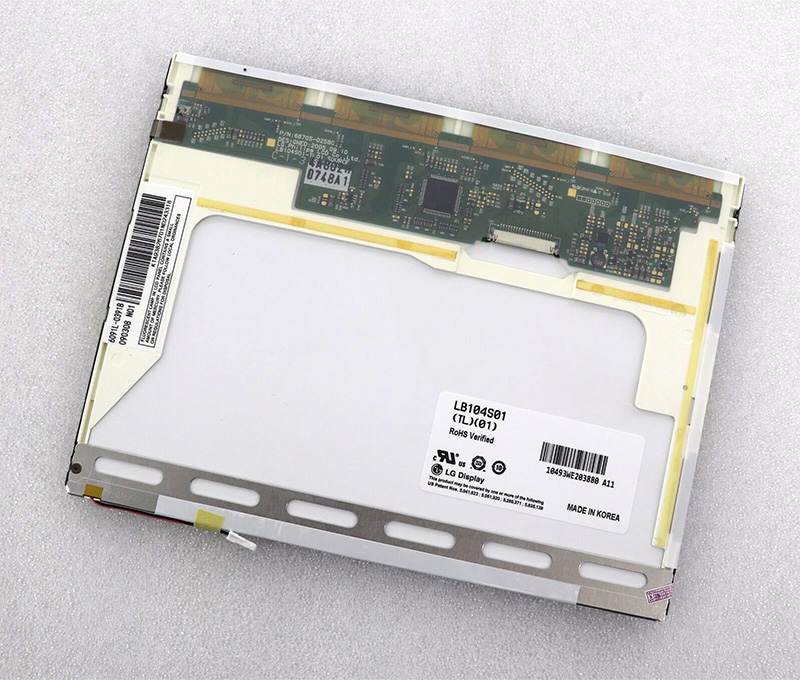

For engineers tasked with maintaining legacy equipment, the LB104S01-TL01 presents a specific challenge: finding a true "original" panel versus a refurbished or compatible version. The term "Original" in the title refers to the factory-sourced panel from LG.Philips. Counterfeit or third-party "compatible" panels often use substandard CCFL tubes or poor-quality polarizers, leading to premature yellowing or uneven backlight bleeding.
When replacing this panel, one must verify the backlight inverter connector type (usually a JST B6B-PH or similar) and the cable length. The physical mounting holes are standardized to the VESA 75x75mm pattern in most cases, but some OEM enclosures use custom ear mounts. Furthermore, the laser-engraved marking on the metal frame is the best indicator of authenticity. A genuine LB104S01-TL01 will have a date code and a specific QC stamp. Sourcing from certified distributors rather than auction sites is highly recommended to avoid spending hours troubleshooting a dead-on-arrival panel. It is also worthwhile to note that this panel is end-of-life (EOL) by the original manufacturer; thus, long-term stockpiles or reverse-engineered alternatives are becoming the norm in the aftermarket.
Is the LB104S01-TL01 a touch screen panel?
No. This is a standard TFT-LCD panel without a touch sensor. A touch overlay must be added by the system integrator if needed.
What is the operating temperature range for this panel?
Typically, it operates from 0°C to +50°C (ambient). Storage temperature can range from -20°C to +60°C.
Can I replace a broken panel with any 10.4-inch LVDS screen?
No. Physical dimensions, LVDS pin mapping (JEIDA versus VESA), and clock timing must match exactly to avoid damage.
What is the expected lifespan of the CCFL backlight?
The typical operational life is 50,000 hours at standard brightness settings, after which the lamp may dim or flicker.
Does this panel support 1080p or higher resolution?
No. It is a native 800x600 (SVGA) panel. It cannot process higher input signals without an external converter.
How do I connect this to a Raspberry Pi?
You will need a specific LVDS converter board that outputs the correct 40MHz clock and 3.3V/5V power for this panel. A standard HDMI to LVDS board must be configured for 800x600.
What is the brightness level of the LB104S01-TL01?
The typical brightness is 400 cd/m² (nits), which is suitable for indoor industrial use.
Is the viewing angle good?
It uses TN technology, so horizontal viewing angles are around 70 degrees with contrast inversion on vertical extremes. It is not an IPS panel.
Can I convert the video input to VGA or DVI?
Yes, but a dedicated timing controller (T-CON) board is required to strip the sync signals and convert them to a compatible LVDS format.
How do I clean this LCD panel safely?
Use a soft, lint-free cloth lightly dampened with water or isopropyl alcohol. Do not spray liquid directly onto the panel.
Conclusion: The Enduring Utility of a Specialized Tool
The 10.4inch Original 800x600 LB104S01-TL01 LCD panel is a testament to the philosophy that "good enough" is often the highest form of engineering excellence when applied to the right context. It is not a screen for entertainment; it is a tool for production. Its legacy lies in its specific design choices: the robust CCFL backlight for low flicker, the precise 4:3 ratio for data density, and the strict LVDS interface for noise immunity. For professionals maintaining medical ventilators or CNC milling centers, this panel represents a known quantity—a component that behaves predictably over a decade of service. As the industry slowly transitions to LED-backlit replacements, the LB104S01-TL01 remains a crucial bridge between older system architecture and modern reliability requirements.
Whether you are a technician performing a repair or a system architect designing a new HMI, understanding this panel's nuances allows you to make informed decisions. Ultimately, the value of a component is not measured in pixels per inch, but in the stability and precision it brings to the critical task at hand. Choose your components wisely, and prioritize compatibility over raw specifications.