- Industrial LCD display
-
Industrial Products
- DC Servo Drive
- AC Servo Drive
- other
- Heidelberg
- FANUC
- IFM
- Meter
- CCD
- Membrane Keypad
- Film
- YOKOGAWA Module
- Card
- ABB
- MITSUBISHI
- FANUC
- KEYENCE
- BECKHOFF
- Honeywell
- HOLLYSYS
- FUJI servo drives
- HP
- solenoid valve
- thermostat
- Siemens adapter
- color oscilloscope
- Fujitsu connector
- CHELIC
- SMC
- CISCO Module
- INTEL
- Key board
- FAIRCHILD
- Motherboard
- Board
- Bearing
- other
- Control Panel
- Contactor
- Circuit
- OMRON
- Relay
- Controller
- Photoelectric Switch
- Photoelectric Sensor
- Original
- Fan
- Motor Driver
- Limit Switch
- Amplifier
- power supply
- LENZE
- Cable
- Encoder
- Sensor
- Transformer
- Fiber Optic Sensor
- Protection Relay
- Temperature Controller
- Proximity Switch
- Switch Sensor
- Siemens
- Industrial board
- HMI Touch Glass
-
HMI Full Machine Whole unit
- OMRON HMI Touch Panel
- Siemens HMI Touch Panel
- Mitsubishi HMI Touch Panel
- Allen-Bradley automation HMI Touch Panel
- DELTA HMI Touch Panel
- EVIEW DELTA HMI Touch Panel
- KINCO DELTA HMI Touch Panel
- HITECH HMI Touch Panel
- WEINTECK HMI Touch Panel
- TECVIEW HMI Touch Panel
- WEINVIEW HMI Touch Panel
- PRO-FACE HMI Touch Panel
- SIMATIC HMI Touch Panel
- AMPIRE HMI Touch Panel
- HEIDELBERG HMI Touch Panel
- PANASONIC HMI Touch Panel
- PATLITE HMI Touch Panel
- KYOCERA HMI Touch Panel
- KEYENCE HMI Touch Panel
- WEINVIEW HMI Touch Panel
- HITECH HMI Touch Panel
- FUJI HMI Touch Panel
- HAKKO HMI Touch Panel
- SCHNEIDER HMI Touch Panel
- SAMKOON touch panel
- other
- Module
- lcd inverter
- Membrane Keypad Switch
- Winni Touch Screens
- Frequency Inverter
- Servo Motor
- PLC



LAM070G133A Original AUO 7.0" LCD screen
The LAM070G133A Original AUO 7.0" LCD Screen: A Deep Dive into Industrial Display Excellence
In the world of industrial automation, medical devices, and specialized human-machine interfaces, the choice of a display panel is far from trivial. While consumer electronics often dominate headlines with vibrant AMOLEDs and high-refresh-rate panels, the backbone of critical infrastructure relies on robust, reliable, and precisely engineered LCDs. One such component that has garnered significant attention from engineers and procurement specialists is the LAM070G133A, an original 7.0-inch TFT LCD module manufactured by AU Optronics (AUO). This article aims to move beyond superficial specifications, offering a deep, technical exploration of this specific panel. We will dissect its core architecture, evaluate its performance in demanding environments, and analyze its role across various industrial sectors. From rigorous environmental tolerances to optical characteristics and long-term supply chain considerations, we will provide a comprehensive guide for professionals seeking to understand why the LAM070G133A remains a benchmark for quality and durability in the mid-sized industrial display market. Whether you are integrating it into a new design or sourcing a replacement, this analysis offers the critical insights needed for informed decision-making.
Decoding the Nomenclature and Core Architecture
To understand the value of the LAM070G133A, one must first decode its specifications. At its heart, this is an a-Si TFT (Amorphous Silicon Thin-Film Transistor) active matrix LCD module. The "LAM" prefix typically designates a specific series tailored for industrial and high-reliability applications, distinguishing it from standard commercial-grade panels. The "070" clearly indicates a 7.0-inch diagonal screen size, a sweet spot for portable medical equipment and embedded control panels.
Crucially, the LAM070G133A employs a TN (Twisted Nematic) technology. While TN panels are often viewed as inferior to IPS in consumer contexts for color off-axis viewing, they offer distinct advantages in industrial settings. TN technology provides significantly faster response times and lower power consumption compared to its more complex counterparts. Furthermore, AUO has engineered this specific model with a native resolution of 800 x 480 pixels (WVGA). This aspect ratio (5:3) is ideal for displaying standard video feeds and control dashboards without awkward scaling. The interface is a parallel 18-bit RGB, a reliable standard that guarantees low latency and straightforward integration with most embedded controllers and ARM-based processors. The architecture is driven by a LVDS (Low-Voltage Differential Signaling) interface, ensuring signal integrity over short distances within the device chassis.
Optical Performance: Brightness, Contrast, and Viewing Angles
The optical characterization of the LAM070G133A is where its industrial pedigree truly shines. Standard consumer displays often prioritize high resolution and wide viewing angles above all else, but the LAM070G133A optimizes for visibility and readability under harsh ambient lighting. A standout specification is its exceptional brightness, rated between 400 to 450 cd/m² (nits). This high luminance level is non-negotiable for applications like medical carts in bright hospital rooms or outdoor kiosks exposed to direct sunlight.
Complementing the high brightness is a contrast ratio typically rated at 500:1 or higher. While this may seem modest compared to today’s OLED panels (which can reach 1,000,000:1), in an LCD context, a stable 500:1 ratio provides adequate differentiation between black and white pixels for reading text and identifying UI elements. The critical trade-off here is the viewing angle. With TN technology, the LAM070G133A offers typical viewing angles of 70° (left/right) and 60° (top/bottom). Off-axis, contrast inversion can occur. However, in a fixed-position industrial monitor, the operator is almost always sitting directly in front of the screen. The panel's anti-glare treatment minimizes surface reflection, effectively diffusing ambient light sources and preventing distracting specular highlights that would compromise data readability in high-brightness environments.
Environmental Ruggedness: Temperature, Vibration, and Longevity
Perhaps the most defining characteristic of the LAM070G133A is its robust environmental tolerance. An industrial-grade display must function flawlessly in conditions that would quickly destroy a consumer laptop screen. This panel is engineered for an operating temperature range of -20°C to +70°C, with a storage range extending from -30°C to +80°C. This thermal resilience is achieved through specialized liquid crystal mixtures that do not freeze or degrade at low temperatures and maintain viscosity at high operating temperatures.
Beyond temperature, the module incorporates a high mechanical reliability. The assembly is often designed with metal frames and secured PCB connections to withstand continuous vibration and shock, a common reality in factory automation or transportation applications. Furthermore, the LED backlight unit within the LAM070G133A is selected for longevity, with a specified lifetime of 50,000 hours under normal operating conditions. This translates to over five years of continuous 24/7 operation. For mission-critical systems, such as patient vital signs monitors or industrial process controllers, this long backlight lifespan significantly reduces the total cost of ownership by minimizing downtime for lamp replacement. The module also features a standard 12V LED driver input, simplifying power supply design for integrators.

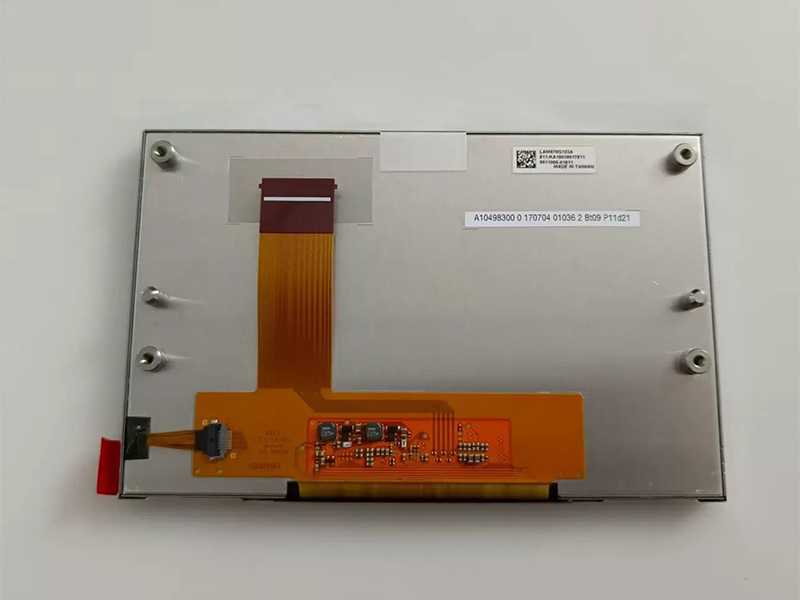
Interface and Integration: The LVDS Connection
Successful integration of any LCD module hinges on a clean electrical interface. The LAM070G133A utilizes the widely adopted LVDS (Low-Voltage Differential Signaling) standard. This is not merely a technical detail; it is a strategic advantage for system designers. LVDS separates the data into differential pairs, which significantly reduces electromagnetic interference (EMI) and allows for reliable data transmission at high speeds over longer distances than a parallel TTL interface. For the LAM070G133A, which requires transferring 18 bits of color data, LVDS simplifies the cable routing.
The module typically uses a 30-pin JAE or compatible connector, a common form factor found in development kits and embedded computers. The signal mapping includes clock and data lanes (typically 4 data lanes for 18-bit RGB). For system integrators, the output LVDS timing settings are well-documented. The panel expects a pixel clock rate of approximately 33 MHz. This manageable timing requirement means that even mid-range microcontrollers or SoCs (System on Chips) can drive the display without needing expensive, high-speed LVDS transmitters. This compatibility makes the LAM070G133A a favorite for PCB designers building custom ARM or x86-based industrial computers, as it integrates seamlessly with common LVDS transmitter chips like the SN75LVDS83 or its newer equivalents.
Application Landscape: Where the LAM070G133A Excels
The true test of a component is its real-world application. The LAM070G133A is not a general-purpose display; it occupies a specialized niche in three primary domains. First and foremost is the medical sector. Its high brightness and excellent readability are ideal for patient monitors, infusion pumps, and anesthesia machines. In a surgical or critical care environment, reliability is paramount, and the wide temperature range ensures the screen functions correctly during sterilization cycles and varying room temperatures.
Second, the industrial automation and HMI (Human-Machine Interface) market. Factory floors are dirty, dusty, and subject to temperature fluctuations. The LAM070G133A is a common sight in CNC machine panels, PLC programming terminals, and robotic control pendants. Its VGA resolution (800x480) is perfectly adequate for displaying machine status, alarms, and production data without the performance overhead of driving a high-resolution panel. Third, specialized handheld terminals and portable measurement devices. The 7.0-inch size provides a large enough viewing area for detailed schematics or waveforms while maintaining a compact form factor for portability. While it has been replaced by newer modules in some premium applications, its legacy in proven, long-life industrial designs remains strong and it is frequently sourced as a drop-in replacement for installed equipment.
Supply Chain, Sourcing, and the Legacy of an Original AUO Panel
Navigating the procurement of a proven industrial display like the LAM070G133A requires understanding its lifecycle. Unlike consumer gadgets that are obsolete within a year, industrial components are often produced for 5 to 10 years. However, this model is now entering its "mature" lifecycle phase. Original AUO "G" series panels are highly sought after for aftermarket repairs and long-term system maintenance. Finding a genuine LAM070G133A is critical because counterfeit or "compatible" panels may use lower-grade backlights with significantly shorter lifetimes or have different connector mappings.
The key to successful sourcing is verifying the "Original AUO" designation. Reliable distributors will provide a full datasheet and lot traceability. The biggest risk in the supply chain for this model is not the LCD itself, but the dedicated controller board (if not using a direct LVDS connection). Many industrial designers pair this panel with a compatible VGA/DVI converter board. As the panel ages, support for these controller boards may wane. Therefore, when integrating the LAM070G133A into a new design, engineers should carefully evaluate the future availability of driving electronics. For replacement projects, always order from a reputable vendor that stocks original AUO modules to avoid premature backlight failure and mechanical mis-alignments.
Frequently Asked Questions (FAQs)
Q: What is the resolution of the LAM070G133A?
A: It is WVGA resolution: 800 pixels horizontally by 480 pixels vertically.
Q: Is this an LCD or an OLED panel?
A: It is a TFT-LCD panel using a-Si technology; it is not an OLED.
Q: What is the typical brightness?
A: Typically 400 cd/m², but can be specified up to 450 cd/m² for high-brightness variants.
Q: Can I use it outdoors?
A: Yes, due to its high brightness and anti-glare surface, it is suitable for outdoor kiosks in shaded or semi-direct sun, provided the ambient temperature remains within -20°C to +70°C.
Q: What interface does it use?
A: It uses a single-channel LVDS interface with 6-bit (18-bit color) data input.
Q: Is a touch panel included?
A: No, the LAM070G133A is typically sold as a bare LCD module. However, AUO often offers compatible touch panels (resistive or capacitive) that can be bonded or attached.
Q: What is the lifespan of the backlight?
A: The LED backlight typically has a life expectancy of 50,000 hours.
Q: Is it compatible with a Raspberry Pi?
A: Not directly. The Pi outputs HDMI or DSI. You would need an LVDS-specific driver board or a custom interface (e.g., using an FPGA) to convert the signal.
Q: What are the viewing angles?
A: It uses TN technology, offering approximately 70° left/right and 60° top/bottom.
Q: Is the LAM070G133A a discontinued part?
A: While no longer a "leading edge" product, original AUO stock remains available through industrial distributors for repair and legacy projects. It is not end-of-life (EOL) in terms of market availability.
Conclusion: A Benchmark in Functional Display Reliability
The LAM070G133A from AU Optronics is far more than a simple glass panel. It stands as a testament to the engineering discipline required for industrial displays, where longevity and environmental resilience outweigh consumer-centric metrics like pixel density. This 7.0-inch module delivers a carefully balanced combination of high visibility, robust mechanical design, and proven electrical standards that have made it a mainstay in medical and automation equipment.
For engineers and procurement managers, understanding this panel means recognizing that the most effective display is not necessarily the newest or the brightest, but the one that integrates seamlessly and operates reliably for years. While the technology landscape evolves with IPS and OLED panels, the LAM070G133A remains a compelling choice for projects where stability, cost-effectiveness, and guaranteed compatibility are the primary objectives. Whether you are replacing a failed unit or designing a new system that must last a decade, this original AUO panel offers a level of functional reliability that is increasingly rare in today’s disposable electronics market. Choose it for its track record, not its novelty.